

AI tools are transforming market research by saving up to 40% of research time. Here’s how businesses are leveraging AI to streamline tasks and gain actionable insights:
- 65% of professionals now use generative AI tools, up from 33% last year.
- Key uses include synthesizing transcripts (62%), analyzing data (58%), and generating reports (54%).
- Tools like PromptDrive.ai automate data collection, monitor brand reputation, predict trends, and build customer personas.
- Writing clear AI prompts with six components – Persona, Context, Task, Format, Exemplars, and Tone – improves research accuracy and speed.
Quick Tips for Writing Effective AI Prompts:
- Define the AI’s role (e.g., "Act as a market analyst").
- Provide clear context (e.g., "Analyze Q1 2025 electric vehicle trends").
- Specify the task and desired output format.
- Use data variables like timeframes and market indicators for precision.
With tools like PromptDrive.ai, teams can collaborate on prompts, organize research projects, and integrate multiple AI models in one workspace for just $10 per user/month. This approach not only simplifies workflows but also enhances decision-making with AI-driven insights.
Master the Art of Prompt Writing: 6 Tips To Writing Better Prompts | Copy.ai
Writing Clear AI Prompts for Research
Crafting effective AI prompts is essential for producing accurate and actionable market research. With 45% of professionals already using generative AI and another 45% planning to adopt it, the trend is rapidly growing [1].
Basic Rules for Writing Prompts
To create precise and insightful outputs, six key components should be included in your AI prompts:
| Component | Purpose | Example for Market Research |
|---|---|---|
| Persona | Defines the AI’s role | "Act as a senior market analyst with 15 years of experience" |
| Context | Provides background information | "Analyzing the US electric vehicle market in Q1 2025" |
| Task | Clarifies the objective | "Identify emerging consumer preferences" |
| Format | Specifies the output structure | "Present findings in a detailed report with key statistics" |
| Exemplars | Offers a template or framework | "Include sections on pricing trends, feature demands, and purchase barriers" |
| Tone | Sets the communication style | "Use professional, data-driven language" |
When these components are thoughtfully applied, the results can be highly effective. For instance, EY Americas reported a 95% alignment between synthetic and actual CEO survey responses using well-structured prompts [1].
Using Data Variables in Prompts
Incorporating specific data variables can significantly enhance the accuracy of AI-driven research. Here are a few ways to do this:
- Timeframe specifications: Clearly define the time period, such as exact dates or quarters.
- Market indicators: Include relevant metrics like market share, growth rates, or sales figures.
- Geographic parameters: Specify the regions or markets being analyzed.
To ensure high-quality outputs, follow these best practices:
- Standardize and clean data to avoid duplication before inputting it into AI [3].
- Use multiple sources to capture a broader range of patterns.
- Regularly update prompts to account for changes and prevent data drift.
- Continuously review AI outputs for accuracy and refine based on user feedback.
"While AI can be a great tool throughout marketing processes, human touch and intuition will always be needed to ensure your messaging will resonate with and engage your audience", says Melissa Nascimento, executive vice president of marketing at Larken Associates [4].
Common Market Research Tasks Using AI
AI has reshaped market research by speeding up tasks like competitor analysis, synthesizing customer feedback, and spotting trends. With the right prompts, businesses can automate these processes, saving time while gaining valuable insights.
Analyzing Competitors
AI has revolutionized how companies keep tabs on their competitors. By automating data collection and analysis, businesses can stay updated on their competitive environment without the manual legwork [5].
| Analysis Type | Prompt Focus | Output Format |
|---|---|---|
| Pricing Strategy | Current pricing, discounts, bundles | Comparative tables with price trends |
| Product Features | Key differentiators, new releases | Feature matrix with gaps analysis |
| Marketing Tactics | Channel usage, messaging themes | Channel-specific strategy breakdown |
AI tools can generate detailed reports quickly, presenting data in formats like comparison tables or feature matrices. This allows businesses to identify gaps and opportunities almost instantly [5]. The same approach can also uncover patterns in customer behavior.
Understanding Customer Behavior
AI excels at processing large amounts of customer feedback to uncover trends and actionable insights. For example, a major telecommunications provider used AI to analyze data from social media, reviews, and call transcripts. This analysis revealed network issues that were driving customer churn [7].
Netflix is another standout example. The company leverages AI to analyze customer preferences, which helps them:
- Make decisions on content investments
- Understand viewing habits
- Predict the success of new shows
- Provide personalized recommendations [7]
"Just remember: your results are only as good as your prompts. Include details. Write like a human – because the best answers come from AI that thinks it is one." – Cathy Mitchell [6]
With refined competitor and customer insights, AI can also help businesses identify market trends.
Finding Market Trends
AI can identify trends by analyzing shifts in consumer preferences, changes in product categories, and broader market movements. For instance, small fashion businesses use AI prompts to evaluate competitor pricing and marketing strategies for seasonal collections. This helps them adjust their own pricing and refine marketing campaigns [8].
To get the best results, craft prompts with clear objectives and specific context. The more focused the input, the more actionable the insights [2].
sbb-itb-ce50508
Team Features in PromptDrive.ai
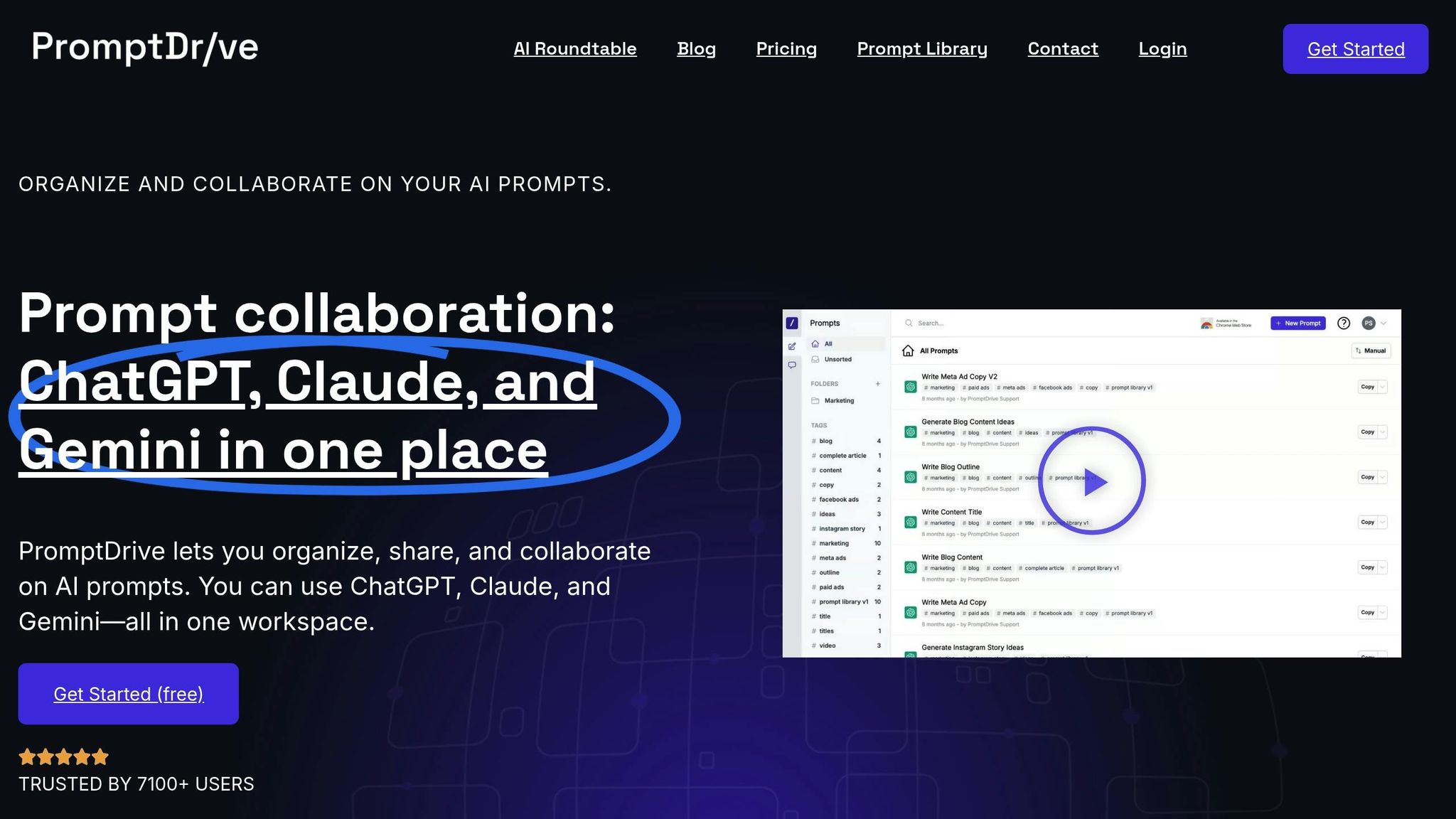
PromptDrive.ai brings together prompt management, team collaboration, and AI model integration, creating a unified workspace that simplifies market research.
Managing Prompt Collections
With PromptDrive.ai, teams can organize their research prompts using an intuitive folder and tagging system. This setup allows for effortless management of projects, whether they’re focused on specific market segments, research topics, or client accounts. The built-in search functionality makes finding the right prompt quick and easy.
| Feature | Benefit | Use Case |
|---|---|---|
| Folders | Organize prompts by project/theme | Industry-specific market analysis |
| Tags | Filter and categorize quickly | Product research topics |
| Shared Libraries | Centralized access to prompts | Company-wide research templates |
| Variables | Personalize prompts for flexibility | Client-focused competitor analysis |
In addition to organizing prompts, these tools are designed to boost team productivity and streamline workflows.
Team Workflow Tools
PromptDrive.ai strengthens collaboration with features like private sharing, ensuring teams can refine prompts together while maintaining consistency across projects.
"My team has been using your service for a few months and finding it very valuable." – Carrie S
For $10 per user/month under the Business plan, teams gain access to unlimited chat collaboration, private prompt sharing, and access control settings. These features enable research teams to gather feedback, improve prompt quality, and enhance their overall efficiency.
Connecting with AI Models
PromptDrive.ai makes it easy to work with multiple AI models in one place. By integrating API keys for tools like ChatGPT, Claude, and Gemini, teams can run queries directly within the platform. This centralized approach eliminates the need to switch between platforms, allowing for real-time collaboration on prompt refinements and consistent research practices across teams.
"PromptDrive helps me save time while using these tools to save time elsewhere." – James D
The platform also includes a Chrome extension, giving users quick access to their prompt collections while interacting with AI tools. This feature further streamlines workflows, keeping everything accessible and efficient.
Conclusion: Better Research with AI Prompts
AI prompts are reshaping the way market research is conducted, delivering faster and more efficient results. According to recent data, 45% of market researchers are already using generative AI, with another 45% planning to incorporate it into their processes [1]. This surge in adoption has led to a 12.2% increase in task completion rates and a 25.2% improvement in speed [11].
Predictive analytics powered by AI has also made a significant impact, enhancing decision accuracy by 20% and boosting operational efficiency by 30% [9]. EY Americas’ CMO, Toni Clayton-Hine, shared her perspective on this transformation:
"The results were astonishing. The conclusions were 95% the same, the correlations were very strong, and in many cases the numbers were nearly identical" [1]
With tools like PromptDrive.ai, managing and collaborating on prompts has become more streamlined. Teams can now work with multiple AI models from a single interface, simplifying workflows and evolving traditional research methods.
Bill Gates offers a timely reminder about the immense potential of AI:
"We should keep in mind that we’re only at the beginning of what AI can accomplish. Whatever limitations it has today will be gone before we know it" [10]
Projections suggest that AI could add up to $15.7 trillion to the global economy by 2030 [9]. This underscores the importance of adopting AI tools to automate tasks, uncover insights, and make informed strategic decisions. Lanette Shaffer Werner from General Mills highlights how synthetic data is already driving innovation:
"We’re exploring how synthetic data could accelerate and improve our product-ideation processes, increasing the likelihood of finding truly great ideas about how to best serve our consumers" [1]
These advancements demonstrate how integrating AI-driven insights can refine and elevate market research strategies, positioning teams for even greater success.
FAQs
How can AI prompts help make market research faster and more accurate?
AI prompts are changing the game in market research by taking over tedious tasks and delivering insights with incredible speed and accuracy. Instead of spending hours – or even days – sifting through data, these tools can swiftly analyze massive datasets to spot trends, understand customer preferences, and uncover new market opportunities.
Take consumer behavior analysis, for instance. AI tools can provide real-time insights, allowing businesses to tweak their strategies and stay ahead of the competition. On top of that, researchers can use AI to simulate feedback from specific target groups. This approach offers a deeper understanding of audience needs without the hefty costs or time commitment that traditional methods often require. The blend of efficiency and precision makes AI prompts a game-changer for today’s market research.
What makes an AI prompt effective for market research?
An effective AI prompt for market research should be clear, focused, and structured. Start by being specific about what you need to ensure the response is relevant. For instance, include details like the industry you’re working in or the type of data you’re analyzing. This context helps the AI understand your request better.
Make sure to clearly define your objective – whether you’re looking to identify trends, summarize competitor data, or something else entirely. Adding examples of the kind of output you want can also guide the AI in terms of format and tone, making the results more aligned with your expectations.
It’s a good idea to refine your prompts over time based on the responses you receive. This iterative approach improves accuracy. Lastly, use constraints wisely to focus the AI’s output, but don’t make them so restrictive that it stifles creativity. Combining these elements will help you get actionable, insightful results.
How can businesses use PromptDrive.ai to boost team collaboration and streamline market research?
Businesses can use PromptDrive.ai to boost teamwork and simplify market research by automating routine tasks and making data analysis easier. Instead of spending hours gathering and summarizing market data, AI takes care of these time-consuming chores, allowing teams to focus on interpreting the results and making smarter, faster decisions.
AI tools like PromptDrive.ai also improve how teams work together by organizing tasks, monitoring progress, and enabling real-time collaboration. This leads to a smoother, more adaptable workflow, helping teams quickly respond to market shifts. By weaving AI into their operations, companies can save valuable time, cut down on manual labor, and increase overall efficiency.
